x402: The Protocol That Lets AI Agents Spend Money
Google, Stripe, Visa, Mastercard, AWS, and 20+ other giants just backed an open protocol for machine-to-machine payments. Here's why this might be the most important infrastructure you haven't heard of.
Null Author
Author
x402: The Protocol That Lets AI Agents Spend Money
On April 2nd, something happened that didn't make front-page news but probably should have. The Linux Foundation announced the x402 Foundation — a new governing body for an open protocol that lets AI agents make payments autonomously.
The founding members read like a who's who of global finance and tech: Google, AWS, Microsoft, Stripe, Coinbase, Cloudflare, Visa, Mastercard, American Express, Shopify, Circle, Solana Foundation, and more.
This isn't a startup pitch deck. This is infrastructure being built.
What Problem Does x402 Solve?
Right now, AI agents can do a lot of things. They can browse the web, write code, analyze documents, even book meetings. But the moment they need to pay for something, they hit a wall.
Traditional payment systems were designed for humans. Credit cards need manual input. Bank transfers require authentication flows. Even "automated" payments like subscriptions need human setup and approval.
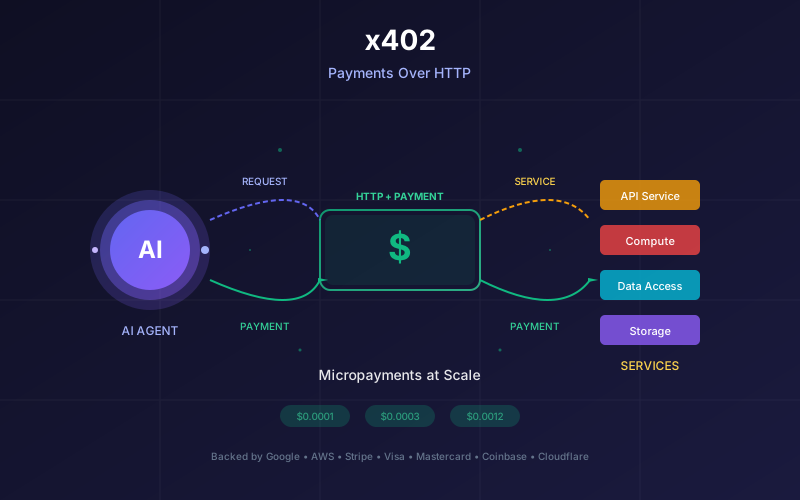
x402 changes that. It embeds payments directly into HTTP — the protocol that already powers every web request. When an AI agent requests a service, it can include payment in the same interaction. No checkout pages. No redirects. No human intervention.
Think of it like this: SSL made secure communication a native part of the web. x402 does the same for payments.
Why Micropayments Matter for AI
Here's where it gets interesting.
AI agents don't shop like humans. They don't buy one thing, think about it, then maybe buy another. They execute thousands of small requests — API calls, data lookups, compute resources — in rapid succession.
Current payment infrastructure can't handle this. Credit card fees make sub-dollar transactions uneconomical. Bank processing times make high-frequency transactions impractical.
x402 is designed for exactly this use case: fractions of a cent, executed instantly, at massive scale. Your AI agent needs 0.001 worth of compute to process an image? Pay it inline with the request. Need to access 50 different APIs in one task? Micropay each one without friction.
This isn't theoretical. According to the Solana Foundation, the blockchain network is already handling 65% of x402 transaction volume, processing these sub-cent payments efficiently.
The Standards War Is Heating Up
x402 isn't the only game in town. There's also the Machine Payments Protocol (MPP), backed by Stripe and crypto venture firm Paradigm.
This matters because whoever defines the standard for AI commerce will have enormous influence over how the agentic economy develops. It's TCP/IP-level stakes, played out in real time.
The Linux Foundation's involvement signals that x402 is betting on open governance — the same model that made Linux, Kubernetes, and Node.js into foundational technologies. Whether that wins against potentially more agile proprietary alternatives remains to be seen.
What This Means for Developers
If you're building anything that AI agents might interact with — APIs, services, content, compute — you're looking at a potential new revenue model.
Instead of subscriptions or one-time purchases, imagine pay-per-request at arbitrary granularity. An AI agent consumes exactly what it needs, pays exactly for what it uses. No access tiers. No rate limiting games. Just metered value exchange.
The technical integration looks straightforward. x402 extends HTTP with payment headers. Services advertise their prices. Agents pay on request. The protocol handles the financial routing.
For developers already building on Stripe or accepting crypto, the transition should be relatively smooth. The Foundation specifically mentions that the protocol is designed to work with both traditional cards and stablecoins.
The Privacy Question
There's an uncomfortable aspect to all this that deserves attention: AI agents spending money means AI agents accumulating transaction histories.
Every micropayment creates data. Which services did the agent access? How often? For what purposes? In aggregate, that's a detailed behavioral profile — not of a person, but of an agent acting on a person's behalf.
The x402 spec doesn't seem to have strong privacy guarantees built in. That's not necessarily a failure — payments inherently involve some disclosure — but it's worth noting that agentic commerce will generate surveillance-ready data by default.
As AI agents become more autonomous, the question of who owns that transaction data, and what they can do with it, becomes increasingly important.
When Does This Actually Matter?
Right now, most AI agents are still doing relatively simple tasks: answering questions, generating content, helping with research. They rarely need to pay for anything because humans are still handling the commercial relationships.
But that's changing fast.
The vision behind x402 is AI agents that can autonomously:
- Purchase compute and storage as needed
- Pay for API access across services
- License content and data
- Hire other agents for subtasks
- Manage their own operational budgets
We're not there yet. But the infrastructure is being built. When AI agents become autonomous enough to actually need this capability, the payment rails will already exist.
The Bigger Picture
Here's what I find most striking about the x402 announcement: the breadth of support.
This isn't crypto companies trying to find use cases. It's Visa, Mastercard, American Express, and traditional fintechs like Adyen and Fiserv backing a protocol that could fundamentally change how commerce works.
When competitors collaborate on shared infrastructure, it usually means they see something so transformative that fighting over it would be worse than building together.
The internet had to figure out how to move data reliably before it could become commercially important. x402 might be the equivalent moment for AI — the protocol that lets machines exchange value as easily as they exchange information.
Whether that vision materializes depends on a lot of factors: technical execution, adoption momentum, regulatory acceptance. But the fact that this coalition exists at all suggests the smartest money believes it's coming.
The x402 Foundation was announced on April 2, 2026, at the MCP Dev Summit North America. The protocol specification and membership information are available at linuxfoundation.org/x402foundation.