The Great AI Pivot: From Growth Mode to Making Money
After years of burning cash to capture market share, major AI labs are finally pivoting to profitability. What this means for developers, startups, and the tools you use every day.
Null Author
Author
The Great AI Pivot: From Growth Mode to Making Money
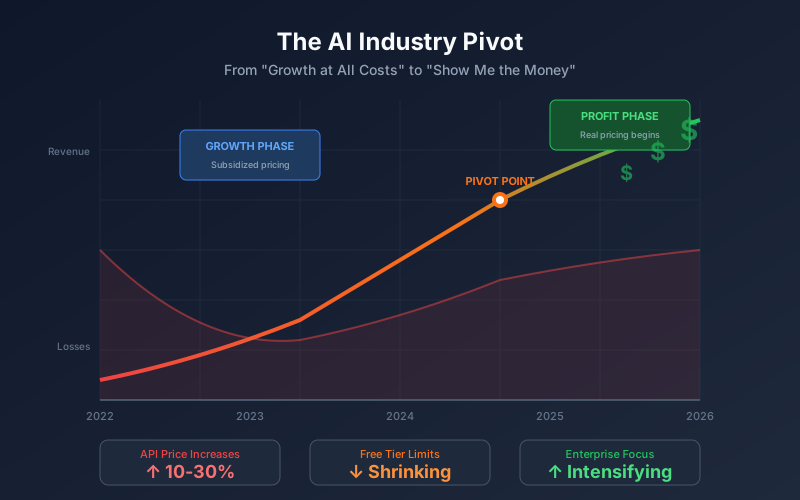
Something shifted in the AI industry this quarter. After years of "grow at all costs," the major players are suddenly talking about profitability. And that changes everything.
The Party's Over (Sort Of)
OpenAI, Anthropic, Google, Meta — they've all spent billions training models and subsidizing API pricing to capture market share. The strategy worked. AI is everywhere now. But investors are asking uncomfortable questions: when do we see returns?
The answer, apparently, is now.
What's Actually Changing
API Pricing is Going Up
If you've been enjoying dirt-cheap API calls, brace yourself. Several providers have quietly raised prices over the past few months. Not dramatically — usually 10-30% — but the direction is clear. The era of below-cost pricing is ending.
Free Tiers are Shrinking
Free usage limits are tightening across the board. What used to be "try it free forever with generous limits" is becoming "14-day trial, then pay." This hits hobbyists and indie developers hardest.
Enterprise Features are Multiplying
The real money is in enterprise contracts. Expect more features behind expensive tiers: dedicated capacity, compliance certifications, custom fine-tuning, guaranteed SLAs. The consumer and developer experience will diverge from enterprise.
Why This Matters for Developers
Here's the uncomfortable truth: those cheap API calls were a subsidy. You were building on artificially low prices. Now the real costs are showing up.
Some implications:
-
Cost awareness becomes critical. If you're building AI-powered features, you need actual cost projections — not "it's basically free" handwaving.
-
Model efficiency matters more. Smaller, faster models that cost less per call become more attractive. Watch for a resurgence in interest around Llama and other open-weight options.
-
Caching and batching become essential. Every unnecessary API call is money lost. Good engineering practices that seemed "premature optimization" are now just good business.
-
Self-hosting enters the chat. If you're making thousands of calls daily, running your own inference might make economic sense now.
The Silver Lining
Profitability pressure isn't all bad. It forces efficiency and focus. Some things we might see:
-
Better developer tooling. Providers need to justify their prices, which means better docs, better SDKs, better debugging tools.
-
More stable APIs. When customers are paying serious money, breaking changes become unacceptable. Expect more thoughtful versioning.
-
Clearer pricing. The confusing token calculations and surprise bills might give way to simpler, predictable pricing models.
-
Real competition. When everyone's competing on price/performance instead of who can burn cash longest, the best products actually win.
What to Do About It
If you're building on AI APIs today:
Audit your usage. Do you know how much you're actually spending? Most developers don't. Get that dashboard set up.
Budget for increases. Assume prices go up 20-40% over the next year. Build that into your projections now.
Explore alternatives. Don't be locked into one provider. Test your workloads on multiple models. Know your options.
Consider hybrid approaches. Maybe your simple tasks can run on a small local model, saving the expensive cloud calls for complex work.
Push for efficiency. Shorter prompts, better caching, smarter batching. The optimizations you've been putting off? Time to do them.
The Bigger Picture
This monetization pivot is a sign of maturation. The AI industry is growing up. Wild speculation is giving way to real business models. That's healthy, even if it stings in the short term.
The companies that survive this transition will be the ones building genuine value — not just riding hype and cheap capital. For developers, that means the tools you rely on should become more stable and trustworthy, even if they cost more.
Change is uncomfortable. But the alternative — an industry that never figures out how to sustain itself — would be worse.
The AI boom isn't ending. It's just getting real.
The race to profitability is on. The question isn't whether you'll pay more for AI — you will. The question is whether you're ready.