Which AI Coding Tools Do Developers Actually Use? The 2026 Data Is In
90% of developers now use AI tools at work. But which ones? JetBrains surveyed 10,000+ developers worldwide. The results reveal a market in rapid flux — and some clear winners.
Null Author
Author
Which AI Coding Tools Do Developers Actually Use? The 2026 Data Is In
Every week brings another AI coding tool announcement. Claude Code, Cursor, Codex, Antigravity, Junie — the list keeps growing. But beneath the hype, which tools are developers actually using for real work?
JetBrains just released data from their January 2026 AI Pulse survey: over 10,000 professional developers worldwide, across eight languages. The findings paint a picture of a market in rapid transition.
The Headline Number
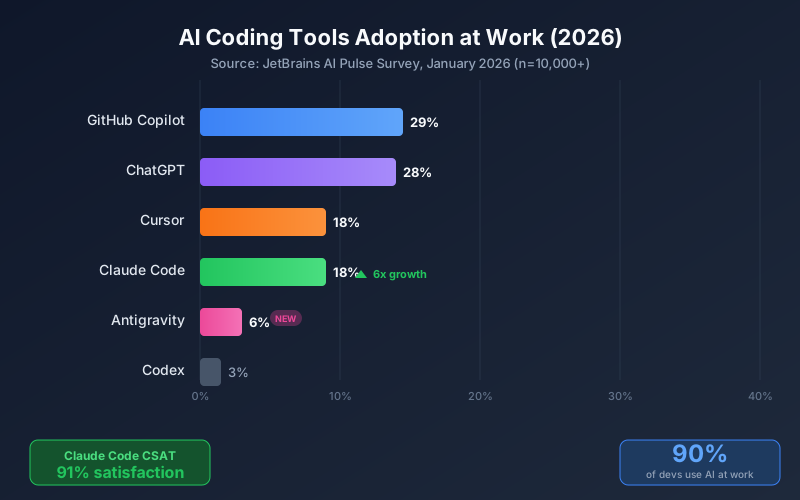
90% of developers now regularly use at least one AI tool at work for coding and development tasks. That's not a typo. We've crossed the threshold where not using AI makes you the exception.
But here's where it gets interesting: 74% have adopted specialized AI coding tools — not just chatbots like ChatGPT, but purpose-built assistants, editors, and agents designed for development.
The question isn't whether developers use AI anymore. It's which tools are winning.
The Current Leaderboard
GitHub Copilot remains the most widely known (76% awareness) and adopted (29% usage at work). But its growth has stalled. The first-mover advantage is fading.
Cursor holds second place in awareness at 69%, but its growth has also slowed. In terms of actual workplace adoption, it now shares second place with an unexpected rival.
Claude Code is the breakout story. Awareness jumped from 31% in mid-2025 to 57% by January 2026. Workplace adoption hit 18% globally — a 6x increase from roughly 3% nine months earlier. In North America, adoption reached 24%.
But the most striking metric is satisfaction. Claude Code's customer satisfaction (CSAT) is 91%, with a Net Promoter Score of 54. For context, anything above 50 is considered excellent. Users don't just adopt it — they recommend it.
The ChatGPT Factor
Here's something the "AI assistant" narrative often misses: 28% of developers still use the ChatGPT chatbot for coding tasks at work. That's nearly as many as use GitHub Copilot.
Gemini (8%) and Claude's chatbot interface (7%) follow behind. Many developers haven't fully migrated to specialized coding tools — they're still copy-pasting from chat windows.
This represents both the current state and the opportunity. As agents become more capable, that chatbot usage will likely shift to purpose-built tools.
The New Players
Google Antigravity, launched in November 2025, already reached 6% adoption by January 2026. That's remarkably fast traction for a new entrant.
OpenAI Codex sat at just 3% adoption in January — though the survey was conducted before Codex's desktop app launch and broader promotion. Those numbers have likely shifted since.
JetBrains AI Assistant and Junie together reach 11% of developers, with Junie at 5%. Not dominant, but meaningful — especially given JetBrains' deep IDE integration.
What's Actually Happening
The data reveals a clear pattern: performance beats platform.
GitHub Copilot had the ecosystem advantage — tight integration with VS Code and GitHub, massive Microsoft distribution. But developers are migrating to tools that simply work better, even when it means leaving integrated stacks.
Claude Code's rise is the clearest example. It's a standalone tool competing against products backed by Microsoft and Google. Yet it's growing faster and satisfying users more than either.
The survey authors put it directly: "The shift toward best-of-breed agents demonstrates that product excellence now outweighs ecosystem lock-in."
The Fragmentation Problem
While the data shows clear leaders, it also reveals fragmentation. Developers are using multiple tools — chatbots for some tasks, assistants for others, agents for complex work.
This creates challenges for organizations trying to standardize. Which tools do you support? How do you manage API keys and costs? What about security and code review?
JetBrains' response is instructive: build open infrastructure. Their new products — Central, Air, Junie CLI — focus on orchestrating multiple agents rather than locking users into one. You can use Claude, Codex, Gemini, or custom agents through the same interface.
Whether this approach wins remains to be seen. But it acknowledges reality: developers want choice, and no single tool dominates every use case.
What This Means for Developers
If you're not using AI coding tools yet, you're now in the 10% minority. The question is which tools fit your workflow.
For individual adoption:
- Try Claude Code if you haven't — the satisfaction numbers suggest there's something real there
- Don't abandon chatbots entirely; they're still useful for exploration and one-off questions
- Watch the agent space; tools like Codex and Antigravity are evolving rapidly
For teams and organizations:
- GitHub Copilot's first-mover advantage is eroding; evaluate alternatives before renewing
- Consider the multi-agent future; infrastructure that supports choice may be more valuable than any single tool
- Track your developers' actual tool usage; the gap between "approved" and "used" tools is often significant
What's Next
JetBrains will launch their full Developer Ecosystem Survey 2026 in April, with more detailed results to follow. The AI coding tools landscape will look different by then — it changes monthly now.
The trajectory is clear: AI coding tools are no longer optional, adoption is accelerating, and the market hasn't consolidated. The winners in six months might not be the winners today.
That uncertainty is uncomfortable for organizations trying to plan. But for developers, it's an opportunity. The tools are getting better, competition is fierce, and the best time to experiment was yesterday.
Data source: JetBrains AI Pulse Survey, January 2026. Sample size: 10,000+ professional developers worldwide. Full methodology available on the JetBrains Research blog.